
Blog / 19 Oct 2026
Identifying Regime Shifts with Language Models
A working paper testing whether a language model can spot why a company might be re-rated before it shows in the share price, and what it would take to turn that idea into a signal.
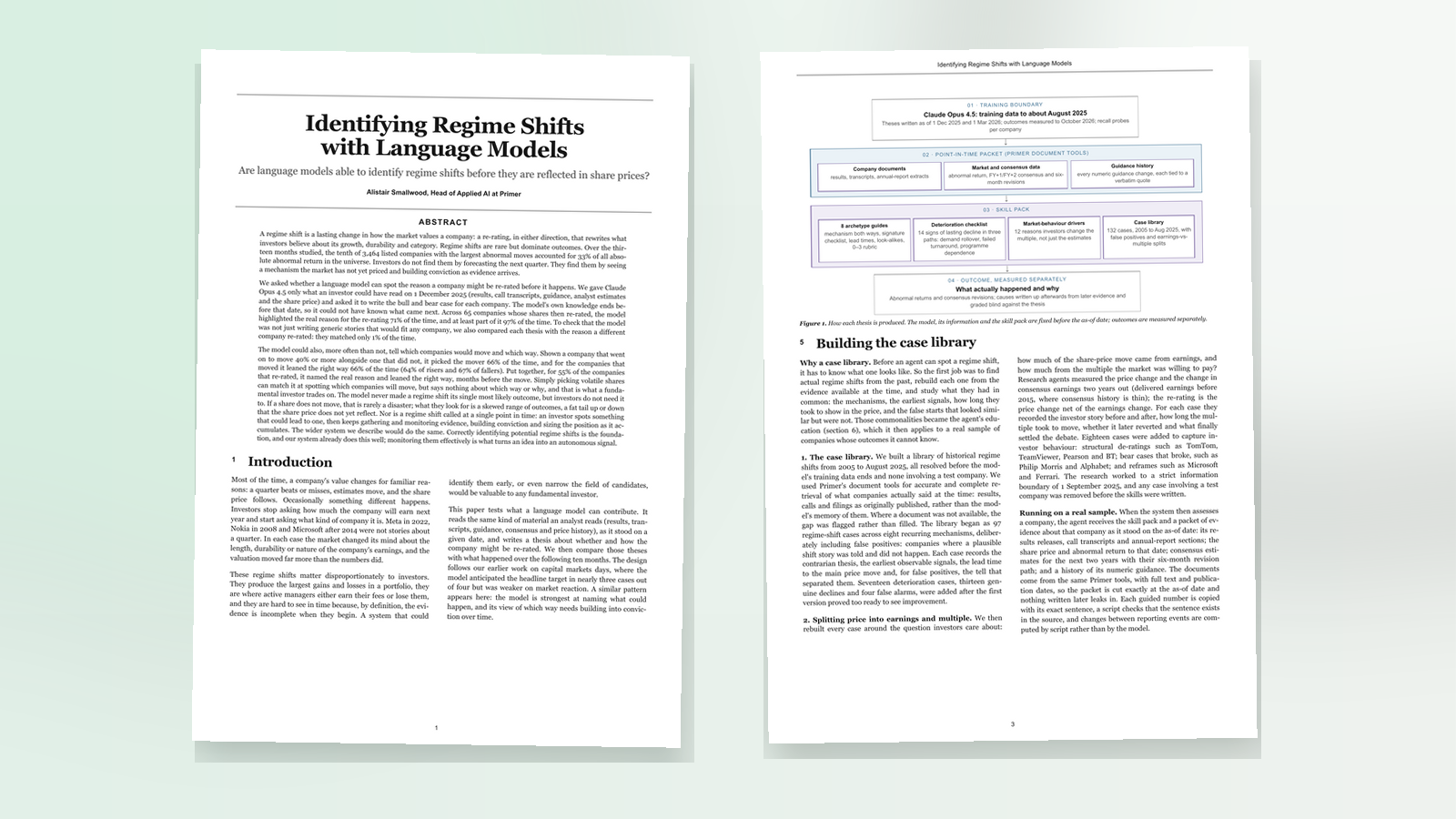
Most of an active investor’s gains and losses come from a few companies the market comes to value very differently: a growth company re-filed as ex-growth, a monopoly re-filed as a utility, a hardware maker re-filed as AI infrastructure. These regime shifts are rare and hard to see in time, because the evidence is incomplete when they begin. Experienced investors spot a possible reason early, then monitor the evidence and build conviction as it arrives.
Identifying Regime Shifts with Language Models asks whether a language model can do the first part. Claude Opus 4.5 read only what an investor could have seen on 1 December 2025, for companies whose outcomes it could not know. Across 65 companies that went on to re-rate, it highlighted the real reason 71% of the time, against 1% when its theses were checked against another company’s reason. Shown a company that moved 40% or more alongside one that did not, it picked the mover 66% of the time, and it leaned the right way for about two in three large movers. It never committed to a call, which is why we argue it belongs inside a wider system that monitors the evidence and turns an idea into a signal.