
Blog / 01 Nov 2026
Predicting Earnings-Day Share Prices with Language Models
A working paper testing whether a language model reading an earnings announcement can predict how the shares will react, and how far its confidence can be relied on.
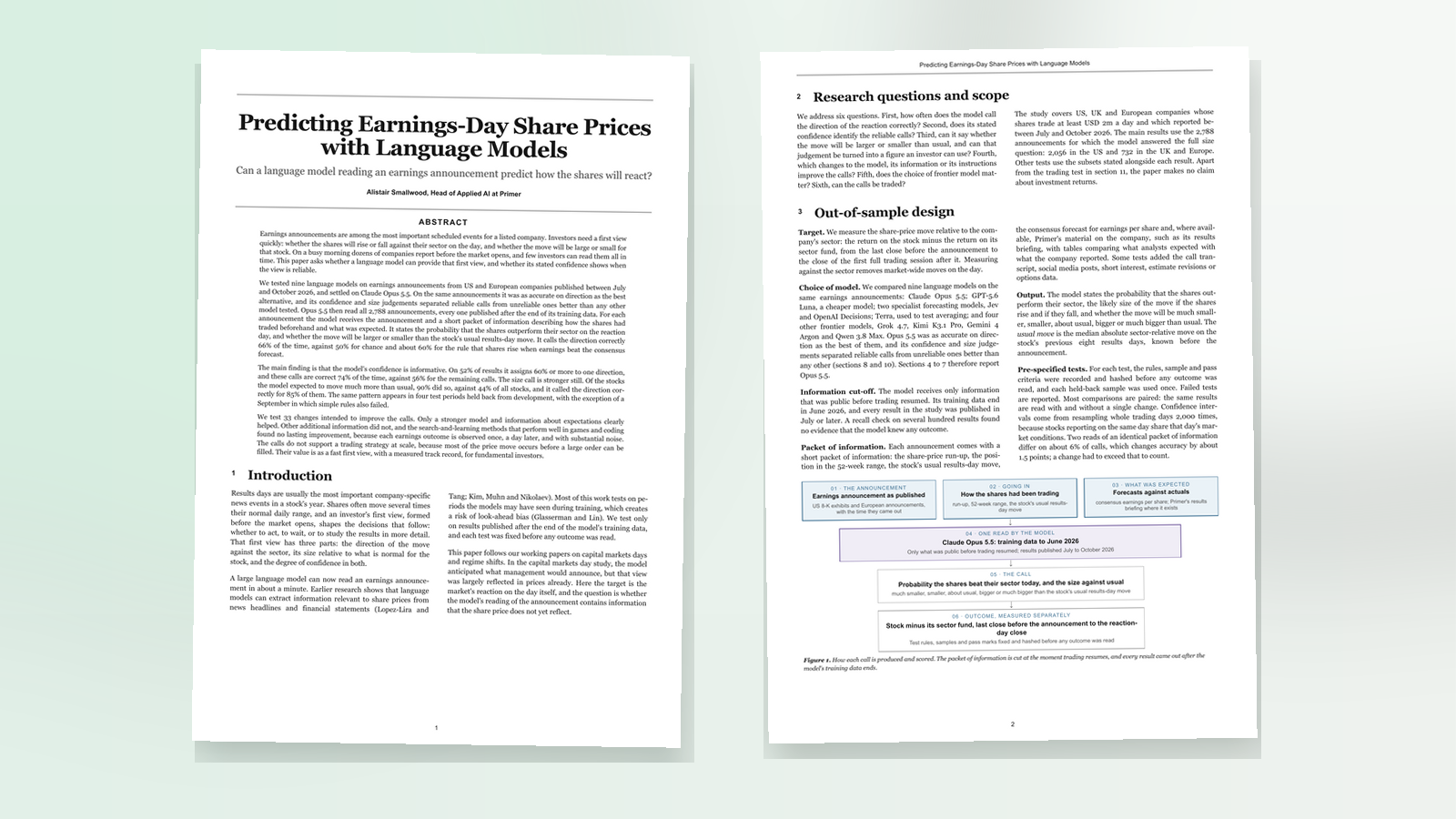
When a company publishes its earnings announcement, investors want a first view before the market opens: will the shares beat or lag their sector today, and will the move be large or small for that stock? On a busy morning dozens of companies report at once, and nobody can read every announcement in time.
Predicting Earnings-Day Share Prices with Language Models asks whether a language model can give that first view, and whether it knows when it can be trusted. We tested nine language models on US and European earnings announcements from July to October 2026 and settled on Claude Opus 5.5, which then read 2,788 announcements published after its training data ends. It called the direction of the reaction against the sector right 66% of the time, and 74% of the time on the half of announcements where it was confident. When it said the move would be much bigger than usual, 90% of those stocks moved more than usual; when it said much smaller, 93% moved less. Of 33 changes we tested, only a stronger model and knowing what was expected clearly helped; search-and-learning methods found nothing that lasted, because each outcome arrives once, a day later, and is noisy. It is not a trading strategy at scale, but a fast, scored first view for fundamental investors.