
Blog / 13 Oct 2026
The best way to set up your company brain
Bring your historic research and new agent work into one company-based workspace, designed for people and agents to use. Here’s why we chose this structure, and what our retrieval tests showed.
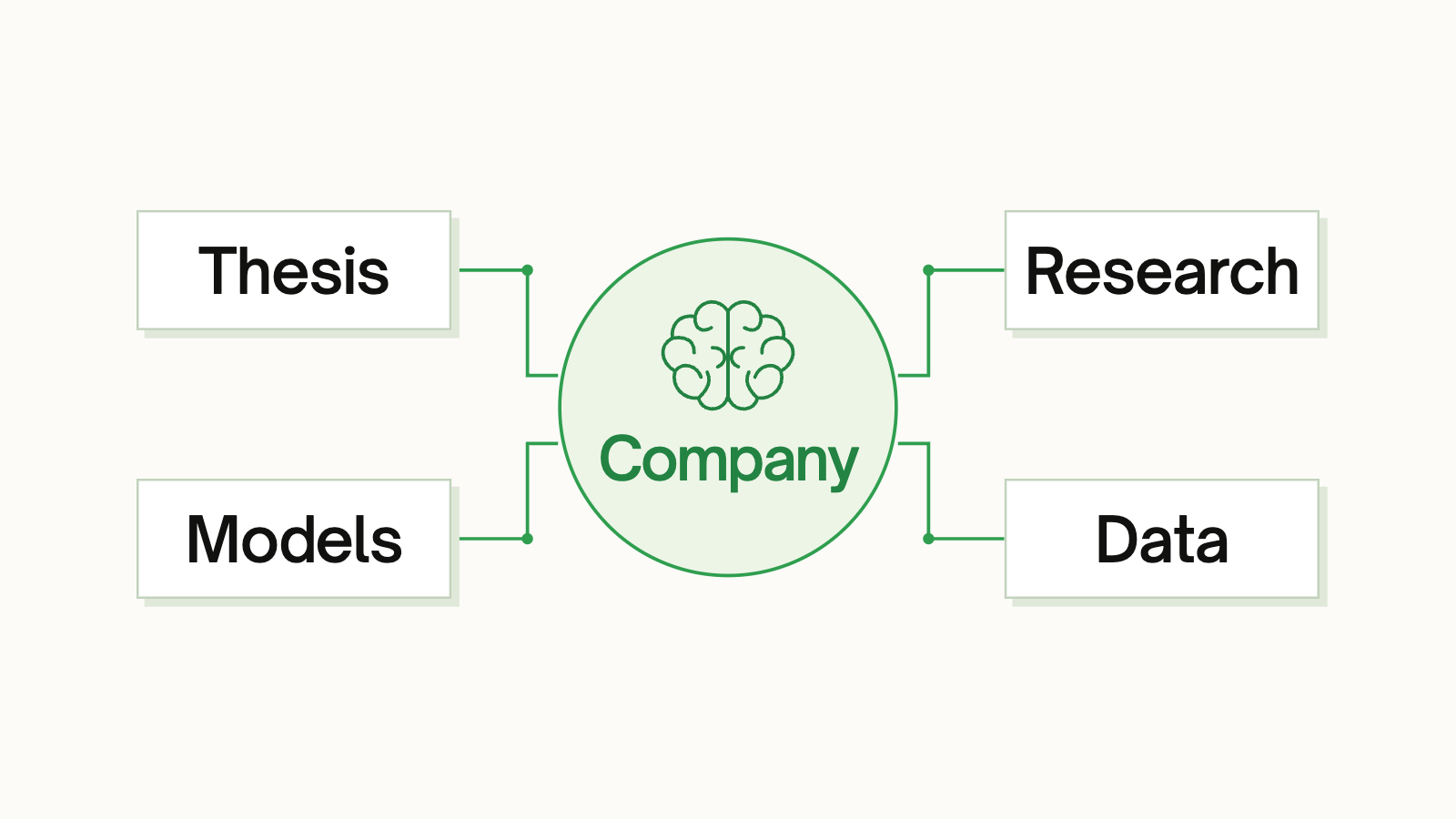
When a customer licenses Primer’s technology, the filesystem we ship gives each company its own research folder. We call this company root. The company’s current view, investment thesis, research, models and source documents all have a clear home.
That home is for the research you already have as well as the work you do next. Historic notes exported from OneNote or another platform can be processed into the same company-based structure. The aim is one source of truth that you and your agent can both read and keep adding to, rather than another separate archive to maintain.
We carefully evaluate our technology and architecture decisions at Primer because we want to ship state-of-the-art technology to our users. Our choice of filesystem is no exception. A folder structure can look sensible to a person and still be difficult for an AI agent to use, especially after years of research have accumulated. So we tested company root against three other ways of storing the same material, first with basic file tools and then with enhanced search.
Company root found all the required evidence in 60 out of 60 attempts when paired with enhanced search. The biggest lesson was how much the tools mattered: they improved retrieval across all four structures and reduced the average time taken. That supports shipping company root with a strong retrieval layer, rather than relying on the folder structure alone.
Company root: base versus enhanced tools
GPT-6 Sol, sixty attempts per setup on the same twenty questions. Complete retrieval means all required source evidence reached the agent. Higher is better; further left is cheaper.
What is a company brain?
A company brain should help your agent understand your own mental model of a business: how you think it works, what you expect to happen and why. It needs to preserve the work that led you to your current view, including what changed your mind along the way.
Your notes, models, data, source documents and investment views belong together because they tell that story. The agent should be able to start with what you think today, then follow the research and assumptions behind it.
It needs to let you:
- Understand your view of the business. Explain what drives its performance, which assumptions matter to you and where you think the risks and opportunities are.
- Follow how you reached that view. Find the investigations, notes, models and sources that shaped it, including evidence that challenged your earlier thinking.
- See what changed. Keep earlier views and forecasts, without confusing them with what you think today.
- Know where information came from. Preserve dates, authorship and source links, and distinguish your assumptions from management’s statements.
- Keep adding to it. Give both you and your agent a clear place to save new research and update existing work.
For example, if you ask whether management’s latest comments support your margin assumptions, the agent needs to know why you made those assumptions in the first place. Your current model, the research behind it and the new comments should all be within reach. You should be able to follow that same trail yourself.
How we set up the evaluation
We wanted to know which way of organising the research helped an agent find the right evidence, and how much time and money it took. We put the same research into four different filesystems, then asked the same questions in each.
The research archive
We built an archive of five fictional companies to test this. It contained 1,397 dated records and about 1.42 million tokens of research text. Three of the companies were related, so some questions required evidence from more than one business.
The archive included company disclosures, analyst notes, model snapshots, datasets, company summaries and investment theses, including older versions. Public-company documents helped ground the initial case. The company histories and relationships were fictionalised or written for the test. Twelve long attachments were adapted from real annual reports, with named entities replaced, and added largely unrelated material for the agent to search through.
That made direct recall of a real issuer less useful, although it doesn’t guarantee that a model could never recognise an adapted document. The 1.42 million tokens also describe the stored archive, not what went into each prompt. The histories varied in depth, and those twelve attachments accounted for much of the text.
The four filesystems
Each layout kept the same source text, dates and metadata. Only the location and organisation of the records changed. These are simplified examples, with company names and filenames shortened for readability.
1. Company root
Each company has its own folder. The current company view and thesis are easy to find, with separate homes for research, data and models, and source documents. Older views stay in the research history.
Company A/
├── company.md
├── thesis.md
├── research/
├── data/
└── files/
2. Chronological notes
Records are filed by date, like a long-running notebook. Notes about different companies sit alongside one another. The agent has to find the relevant entries and work out which views are current.
notes/
├── 2028/
│   ├── 2028-04-18-note.md
│   └── 2028-07-23-model.md
└── 2029/
    └── 2029-02-06-update.md
3. Per-company document
Each company has one large document containing all its research, including models, data and source text. Records appear as dated sections inside it.
company-documents/
├── company-a.md
├── company-b.md
├── company-c.md
├── company-d.md
└── company-e.md
4. Universe document
Everything sits in one large document. It contains all five companies’ records, arranged by date.
universe-research.md
All four layouts are legitimate alternatives: a single document can be easy to search, and plenty of people already organise their work chronologically. We wanted to test them, rather than assume company folders would win.
All four received an equivalent short orientation map listing the companies and their current company and thesis entries. The paths changed with the layout. The map helped the agent get its bearings; it did not contain the answers.
The tools
With base tools, the agent could list files, search their text and read lines from the originals. That is enough to work through an archive, but it leaves the model deciding what to search for and which results to follow.
The enhanced setup kept those tools and added a two-stage search. First, the agent could find ranked records and filter them by company, period, source type or author. It could then search for relevant passages within the records it selected, before opening the source to check the surrounding text.
This follows the same general approach as Primer’s document-processing, search and evidence-finding tools: find the right documents, narrow down the relevant passages, then check the original evidence. The enhanced retrieval layer was a key contributor to company root’s 100% complete-retrieval score in this test. We’ve also written about how document processing and retrieval helped Primer achieve 500 out of 500 on the FinRetrieval benchmark.
The questions and repeat runs
We wrote twenty questions: five asking for a direct fact, five distinguishing peers or similar names, five needing evidence across companies, three checking dates and source roles, and two where the evidence did not support a proposed conclusion. Some asked the agent to separate accepted orders from finished shipments, or to find the information needed to judge a small installation sample.
Before testing retrieval, we gave answering models the relevant excerpts directly. That let us check whether the questions were answerable when the evidence was already in front of them. We also ran smaller filesystem pilots before the full comparison.
For this comparison, Sol had three fresh attempts at each question in every layout and tool setup. That gave us 480 attempts: twenty questions, three tries, four layouts and two tool setups. Each question had an answer date, and the tools could only return records available by then. We weren’t testing whether the agent could spot future information in an unfiltered archive.
Did the right evidence reach the agent?
We were not testing whether the model gave the right answer. That would also test its ability to reason with the information. We wanted to know whether the system surfaced the right excerpts for the question.
For each question, we listed the information those excerpts needed to contain. An attempt passed if the search and file-reading tools showed the agent all of that information, from sources available by the question’s date.
We checked the excerpts the agent actually received, not what it wrote afterwards. Finding the right excerpts counted even if the final answer was wrong. A correct answer without those excerpts did not count. A search preview could count if it contained the required information.
An AI assessor checked the excerpts against our list, without seeing the final answer, model name or filesystem label.
Using the declared scoring rule, complete retrieval rose from 205 out of 240 attempts (85.4%) with base tools to 233 out of 240 (97.1%) with enhanced tools. That is 28 more complete attempts. Every layout improved.
Company root with enhanced search reached 60/60, at an average of about 9.3 US cents and 41 seconds per attempt. That means all the required evidence was shown to the agent in those attempts. It is not a claim that it wrote sixty correct investment answers, or that it will never miss something on a new question.
Higher is better for retrieval; further left is cheaper. Both charts use the same axes. Each dot represents sixty attempts on the same twenty questions.
Base tools
The agent can list files, search text and read the original lines.
Enhanced tools
The agent also has ranked record search and passage search.
The universe document was cheaper and faster than company root with enhanced search, while company root had the highest complete-retrieval score. All four enhanced layouts scored between 95% and 100%.
| Structure | Tools | Complete retrieval | Mean recorded cost | Time / attempt |
|---|---|---|---|---|
| Company root | Base | 55/60 · 91.7% | 10.05¢ | 60.2s |
| Company root | Enhanced | 60/60 · 100.0% | 9.30¢ | 40.9s |
| Chronological notes | Base | 49/60 · 81.7% | 8.78¢ | 54.0s |
| Chronological notes | Enhanced | 58/60 · 96.7% | 9.21¢ | 41.1s |
| Per-company document | Base | 54/60 · 90.0% | 10.04¢ | 49.2s |
| Per-company document | Enhanced | 57/60 · 95.0% | 9.14¢ | 37.0s |
| Universe document | Base | 47/60 · 78.3% | 10.04¢ 59 priced calls | 51.4s |
| Universe document | Enhanced | 58/60 · 96.7% | 8.30¢ | 34.8s |
Enhanced tools reduced the average measured time in all four layouts. Time includes attempt preparation and runner duration under parallel execution, but not queueing before the attempt or judging. These are test timings, not a promise about product response time.
Why we ship company root to customers
Company root had the highest complete-retrieval score in this evaluation. In our view, it is also the best of these four formats for people to read and work with. You can start with the current company view and thesis, then follow the supporting research, models, data and sources in clearly named folders. You don’t have to work through years of notes or one enormous document to understand how the research is organised.
That combination is why we ship company root with our licensed technology. It gives people and agents the same home for historic research and new work, with earlier views kept alongside the current one. Human readability is our design judgment, not a measured result of this eval. The test measured retrieval; it did not measure readability, importing from other platforms, agent write-back, collaboration or permissions.
The other layouts did well too, and the universe document was cheaper and faster. We are choosing a structure for a research workspace customers will keep using and adding to, rather than simply picking the cheapest point on this chart. Company root’s retrieval result supports that choice; it doesn’t prove it will win on every archive.
The tools are the part we’d put most weight on. The same model, working with the same research, found more complete evidence when it could rank records and narrow its search to useful passages. A sensible folder structure still needs a good route from the question to the source.
There are limits to the comparison. These were development questions, not an unseen test set. We refined the evidence key after the answer run, and the figures reproduce that versioned rule. Twenty questions repeated three times are still twenty questions, some sharing evidence, so small score differences shouldn’t be treated as a decisive ranking.
This is the evidence behind the filesystem we ship: company-based organisation that gives the research a clear home, paired with tools that help the agent find the underlying sources. The test supports that setup on this archive. It doesn’t establish production reliability over years of use, which needs separate testing.